
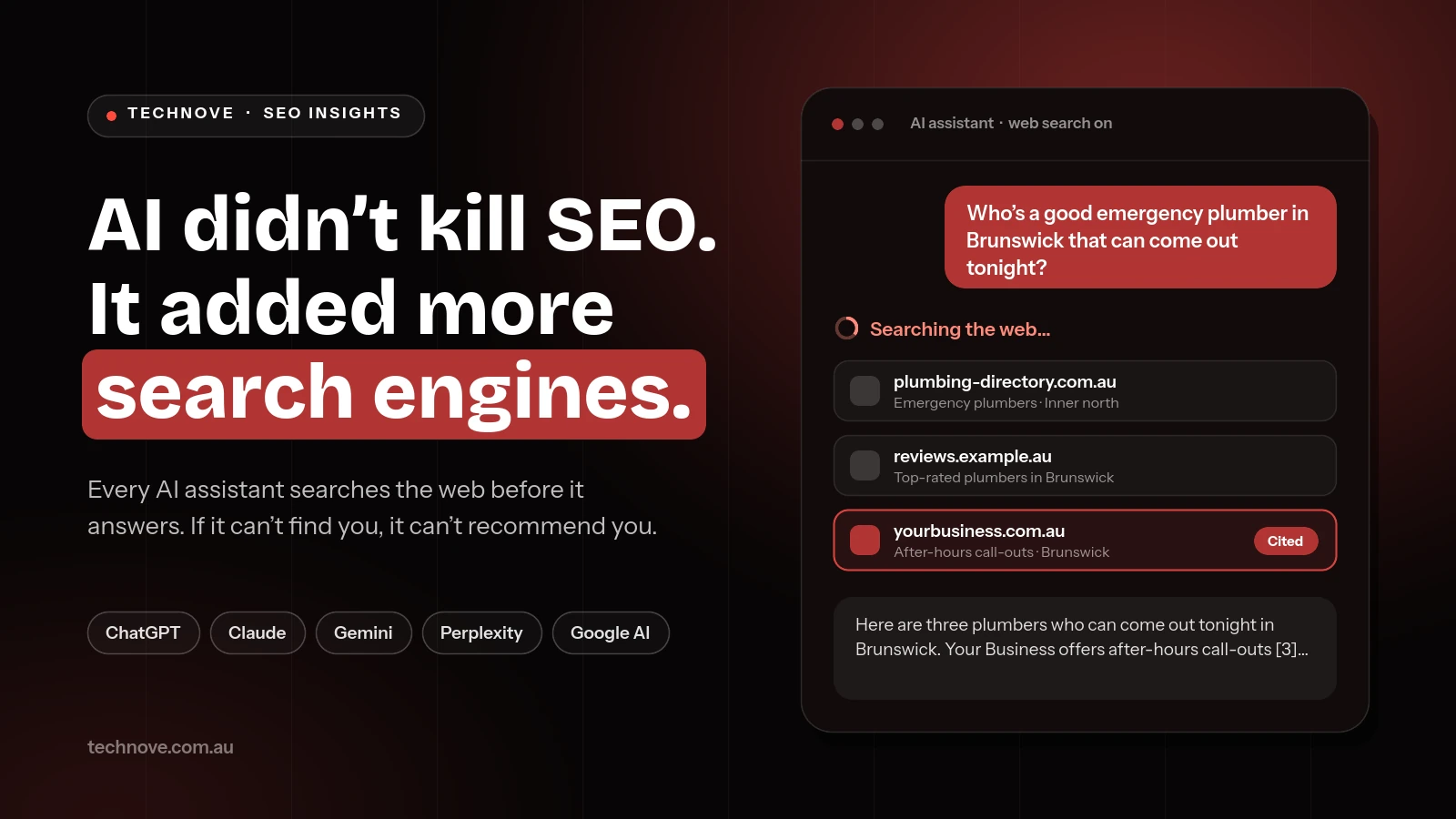
Open any AI assistant (ChatGPT, Claude, Gemini or Perplexity) and ask it something a customer of yours would ask:
“Who’s a good emergency plumber in Brunswick that can come out tonight?”
Before it answers, watch the screen. For a second or two it tells you it’s searching the web. Then the answer arrives with source links beside the business names: a directory listing, a review page, a plumber’s own website.
That pause is the whole argument of this article. The AI didn’t know who the good plumbers in Brunswick were. It went and looked. It ran searches, read the pages that came back, and built a recommendation from what it found.
If your business wasn’t in what it found, you weren’t in the answer.
Nobody Googles anymore, so SEO is dead
We hear a version of this every week at Technove. Usually from a business owner who has read that people now ask AI instead of searching, and who is wondering why they’d keep paying for SEO.
The worry is reasonable. People do get answers inside a chat window now, and fewer of them click through to ten blue links. If SEO only meant “rank on page one of Google so people click you”, that would be bad news.
But that was never really what SEO meant. SEO is the work of making your business findable, readable and trusted by the systems people use to find things. That used to mean Google and Bing. Now it also means every AI assistant your customers talk to. They’re different products, but they share one dependency: pages they can find on the open web.
Every major AI assistant searches before it answers
This isn’t our theory. The companies building these tools say so in their own documentation.
They all run search crawlers. OpenAI has OAI-SearchBot, Anthropic has Claude-SearchBot, and Perplexity has PerplexityBot. Each one exists to read and index the web so the assistant has something to search when a question comes in. Gemini is built on Google, so it draws on Google Search directly.
Block the crawler and you drop out. OpenAI’s documentation says sites that block its search crawler “will not be shown in ChatGPT search answers”. Anthropic says blocking Claude-SearchBot stops Claude indexing your content for search, so your site may show up less prominently and less accurately. The wording differs but the outcome is the same: if the assistant can’t read you, it can’t recommend you.
Google’s AI answers run on ordinary SEO. To appear as a supporting link in AI Overviews or AI Mode, Google says a page must be “indexed and eligible to be shown in Google Search with a snippet”. It adds that no special optimisation is needed beyond that.
So whichever assistant your customer uses, the pipeline looks the same:
- The customer asks a question.
- The AI turns it into one or more web searches.
- It reads the pages that come back.
- It writes an answer from those pages and cites some of them.
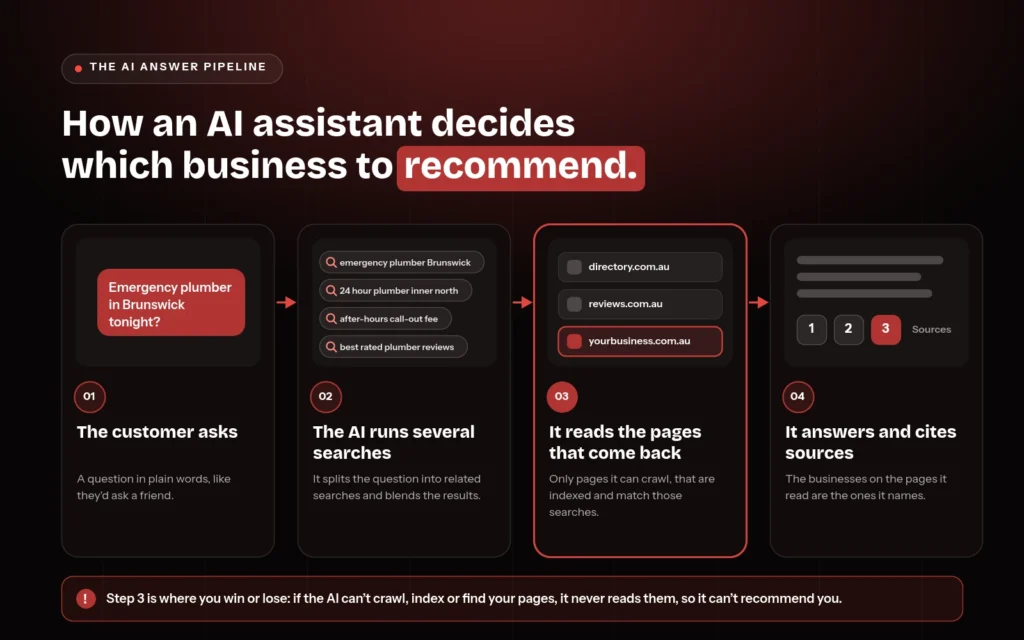
Step 3 is where you win or lose. If your site can’t be crawled, isn’t indexed, or doesn’t come back for the right searches, the AI never reads it. It can’t recommend a business it never saw.
Here’s the catch: ranking #1 on Google isn’t enough on its own
If AI answers simply copied Google’s top result, this would be easy. They don’t.
In August 2025, Ahrefs tested 15,000 long-tail questions across ChatGPT, Gemini, Copilot and Perplexity. They compared the pages each assistant cited with the pages ranking on Google and Bing for the same question. On average, only about 12% of the cited pages were in Google’s top 10 for that exact question. Perplexity was the outlier, at close to 1 in 3.
That sounds like it supports the “SEO is dead” crowd. It actually shows that SEO got broader.
Ahrefs’ explanation is something called query fan-out. Google says its AI Overviews and AI Mode work the same way. The assistant doesn’t search your customer’s exact sentence. It breaks the question into several related searches and blends the results. A page that turns up across many of those searches can beat a page that ranks #1 for just one.
Take the plumber question again. Behind the scenes, the AI might search for:
- emergency plumber Brunswick
- 24 hour plumber inner north Melbourne
- plumber after hours call out fee Melbourne
- best rated plumber Brunswick reviews
A plumber with one strong homepage might rank for the first. A plumber with a page for after-hours call-outs, a page for the suburbs they cover, a clear pricing explainer and plenty of reviews on third-party sites turns up in all four. That second plumber is the one the AI is likely to name, whichever assistant is doing the asking.
That isn’t a new discipline. It’s topical depth, local relevance and reputation, which are core SEO, applied across more searches than before.
What “your SEO is working” means now
If you want AI assistants to recommend you, these are the fundamentals to check. None of them are exotic, and they work across every assistant at once.
1. Let the search crawlers in. Look at your robots.txt. Many sites rushed to block “AI bots” and took out the search crawlers along with the training ones. Most AI companies run them separately: a training crawler (GPTBot, ClaudeBot) and a search crawler (OAI-SearchBot, Claude-SearchBot). You can block training and still allow search. Check that OAI-SearchBot, Claude-SearchBot, PerplexityBot, Googlebot and Bingbot can all reach your important pages. Then check your firewall or CDN bot settings, because those can block a crawler your robots.txt allows.
2. Get indexed, properly. Use Google Search Console and Bing Webmaster Tools to confirm your important pages are actually indexed. A page that isn’t in Google’s index doesn’t exist for Gemini or AI Overviews. If you need enquiries while that work takes hold, Google Ads and broader paid media can put you in front of searchers straight away.
3. Write pages that answer real questions. One page per service (the way our own services page links out to each one), one page per area you serve, and plain answers to the questions customers ask before buying: price ranges, turnaround times, what’s included. Keep them in readable text, not locked inside images or a PDF.
4. Cover the topic, not just the keyword. Fan-out rewards businesses that show up across a cluster of related searches. Map the questions around each service and make sure you have a page that answers each one.
5. Be findable off your own site too. AI answers often cite directories, review platforms, local news and industry lists alongside business websites. Keep your name, address, phone number and services consistent everywhere they appear, starting with your Google Business Profile.
6. Use structured data that matches the page. Schema markup for your business, services, FAQs and reviews helps machines read what a page is about. Google is clear that it should reflect what’s visible on the page, not add claims that aren’t there.
Run this test on your own business today
It takes about fifteen minutes.
- Write down five questions a customer would ask before choosing a business like yours. Include your suburb or city.
- Ask each one in ChatGPT, Claude, Gemini and Perplexity, with web search on, and in Google, where an AI Overview may show.
- Note who gets named, and which pages are cited as sources. You’ll likely see the same few sources across different assistants.
- Open those sources. Look at what they have that your site doesn’t: a dedicated page, a price guide, more reviews, a listing on a directory you’ve never heard of.
- Check your robots.txt for any rule blocking OAI-SearchBot, Claude-SearchBot or PerplexityBot.
If competitors keep getting named and you don’t, the AI isn’t biased against you. It just can’t find enough about you to recommend you. That’s an SEO problem, and it’s fixable.
SEO didn’t die. It got more customers.
The people saying SEO is dead are right about one thing: search has changed. Your customer might never see a page of Google results. They might see a short paragraph from an AI assistant with three business names in it.
But that paragraph is built from the web. The businesses in it are the ones whose pages could be crawled, were indexed, answered the question clearly and showed up across the searches the AI ran. That’s SEO, and it’s the same work whether the customer asks ChatGPT, Claude, Gemini or Perplexity.
So the question isn’t whether SEO still matters. It’s whether yours is good enough for a machine to find you, understand you and put your name in front of the customer.
Want to know how your business shows up when customers ask AI assistants and Google?
Our Melbourne team will check where you appear today, what is holding you back and what to fix first.